
AOCF
Print Articles,

Storytellers

“We love to tell stories, and are driven by that desire to do it for a living.”

Jason Lupish

Creative Director

Open Concept Films


…As the sweat rolls down my brow with relentless fury, I eye the surrounding locale with paranoid trepidation. With my vision shifting from left to right across the vastness of this foreign land, I become aware of one thing; I am not alone out here.

Something stirs in the distance. 200 metres to my immediate right, a movement drifts towards me. The wind, feverishly increasing in velocity, rips dust across the windows of my Audi R8 with a torrid intensity. My eyes squint with ambitious hope, but the images are jagged mirages of the mind.

I insert the key into the ignition and turn. But with the sound of cliché echoing amongst the hissing rattle of desert sand pelting away outside, the engine does not turn over…

The preceding story was written as mere entertainment, but was altered to incorporate one small, seemingly unimportant fact: The endorsement of an Audi R8.

A story can exist for many different reasons. In this regard, however, it comes to exemplify a growing trend in 21st century marketing; the notion of brand marketing.

The idea is a fairly linear one: the fusion of creative storytelling with inconspicuous product placement–A concept that the St. Catharines-based Open Concept Films (OCF) has embraced since their inception in 2010.

Comprising of Jason Lupish, Adam Stephenson (co-Creative Director) and Ralph DeGroot (OCF Producer and Project Manager), the group firmly believes that the days of traditional commercial marketing are on the brink of extinction.

Says Lupish, “For all intensive purposes, corporate video, in its most traditional form, is dead. People want to be entertained. They don’t simply want to be provided with an answer, but rather desire to decipher it on their own.”

Adds Stephenson, “People identify with stories, and they identify with characters and situations. So, in essence, what we we’re doing is telling stories that have interesting and relatable characters. And then we attach a brand to these stories therefore allowing the brand to benefit from the exposure of the film. In essence, we are blending the creative with the commercial”.

Ultimately, this reads as a sincere renouncement of anything associated with the traditional modes of commercial production. Consequently, the company has become fully intent on focusing their energy and passion into the construction of 2-3 minute short films that aspire to advertise a particular product in a very nonchalant sort of way.

“The industry is still in its early stages. In fact, probably more in utero than anything,” says Lupish. “But we’re at the forefront—we’re literally writing the DNA for a new brand of what used to be called corporate video.”

Though seemingly still in a state of infancy, the company has already crafted brand films for such corporations as Halls XS and Brock University. In addition to this, they’ve also donated their time to community projects such as OneWorld Schoolhouse Foundation and the Niagara Catholic School Board.

But an important question does arise. If they’ve encountered such a vast amount of achievement over such a short period of time, why not expand to a major market along the lines of Toronto or Montreal?

The answer is a rather simple one.

“The Niagara Region is my home,” says Stephenson. “When I surround myself with the people that matter to me, I’m able to draw inspiration and feel better about the work I’m producing. I’ve spent years with this group of people and they are all as creative as I am. I don’t want to abandon that.”

Lupish readily concurs, “I’m from St. Catharines, and most of my family is situated here. “It’s not the best excuse but it’s a logical one…And realistically, what with technology being the way it currently is, I can do my job from anywhere in the world.”

It’s a telling statement about how the current technological climate of our society is influencing our methods of choice. With advancement progressing at such a staggering rate over the past 10-15 years, companies no longer fear the need to traverse to the larger cities for further employment. With potential jobs a mere click away, companies are now thriving in smaller markets.

Though the company has been profiting from their branded films (they also offer event coverage, web content production and  produce/direct music videos for local artists), it’s interesting to note that the original idea behind the formation of Open Concept Films had to do with Lupish’s and Stephenson’s other passion; feature films.

In 2010, they had just started work on a film entitled A Kind of Wonderful Thing, but needed a company name to place it under. Thus OCF was (un)officially born. Since then, the film has gone on to garner high acclaim, and in August 2012 had an official red carpet premiere at Brock University.

In October 2012, Open Concept Films continued their ascension as a relevant Niagara-based media group as they packed up and moved their headquarters to 1 St. Paul St. E.—becoming the newest tenant at nGen’s Generator at One Studio.

“This is a huge step for OCF,” says Ralph DeGroot. “All of a sudden, we have moved into the global market with projects for a Brazilian marketing firm, Espalhe, and Kraft Foods. Places like nGen are starting to help facilitate growth of the entertainment industry right here in Niagara, and we’re quite proud to be a part of that.”

But the notion of complacency has never found residency within the mindset of the creative team. Their aspirations are for continual growth, and to create content that is consumed by the masses. Whether that content be through traditional media sources (television, theatre, radio) or new media (Internet), the desire and drive continues to burn.

“We are driven by an innate creativity. Our professional drive has always stemmed from our fascination with the exploration of discovering/creating something new,” says Lupish. “Open Concept Films is, in its most basic sense, filmmakers and storytellers who are dedicated to bringing an artistic sensibility to our work.”

Openconceptfilms.com

a9d
Print Articles,

Danny Zzzz’s Magical Mystery Tour

“The mind is an amazing playground…if you just let it go, and believe it can happen”.

Danny Zzzz


A helicopter hovers fourteen stories above the earth-its propeller whirling ceaselessly, blocking out all surrounding sound. Attached to the copter by a cord, an inverted man dangles precariously in the sky, constricted in his movements by a strait jacket.

Contrary to initial belief, this is not a man being transported to the local asylum. This is entertainer Danny Zzzz, and this is his own idea-an act of courageous fortitude that is all in the name of charity.

The mission is simple: hanging upside down, Danny Zzzz’s goal is to escape the constraints of the strait jacket before succumbing to a fate guaranteed to be much worse.

Even with over twenty years experience in the field, it’s difficult not to fear for Danny Zzzz’s safety as he attempts this Houdini-esque helicopter stunt. As he teeters above the perilous landscape below, Dan has to be terrified, or so the onlookers assume. Instead, Dan focuses his concentration and, within moments of ascent, magically relieves himself of that pesky and constrictive jacket. Dumfounded and awestruck, the spectators breathe a sigh of relief as Dan (with a grin as large as a child’s) is lowered back onto the ground without a sense of concern.

In reality, this is simply just another day in the life of Danny Zzzz, a hypnotist, mentalist, illusionist, magician and entertainer.

A former musician and producer/daytime host at 97.7 htz FM (1995-2001), Dan has always been a man who, more often than not, has succeeded in taking chances (in every regard). Gifted with remarkable business savvy, Dan credits a great deal of his success to serendipity: “I have tended to take career chances at the correct time, but I’ve been very lucky. No matter how astute you are business-wise, there is always a great amount of luck involved.”

Billing himself as the ‘premier choice for quality live entertainment’, Danny Zzzz performs all over North America with his Vegas-inspired show (the Danny Zzzz LIVE! Show). Mixing elements of humor, magical mentalism and comedy stage hypnosis, Dan performs two shows a day, seven days a week. In a normal year, he and his technical crew will conduct over 400 performances (He has amassed over seventeen hundred shows in nine years of existence).

In fact, in one forty-two hour span, Dan and his crew traversed across two provinces (Thorold, Ontario and Calgary, Alberta) and two states (Buffalo, New York and Orlando, Florida) to perform their widely-acclaimed show.

Based here in the Niagara Region, Danny prides himself on producing shows that are suitable for audiences of all ages, which ultimately dictates that there is no offensive language or conduct of any kind. In a medium where pushing the limits relishes being the norm, it’s refreshing to witness an act such as Dan’s refrain from that sort of material and continue to remain a relevant and engrossing spectacle.

This respect for his audience has not been lost on others, either. He has garnered wide acclaim from many of his peers in the industry.

In 2007, NBC premiered a program entitled ‘Phenomenon’, a competition show that featured ten contestants competing to become the next great mentalist. Contending against over forty-four thousand applicants, Danny Zzzz secured his spot during an awe-inspiring video-phone interview with producer Marla Brodsky (he performed a Mentalism effect that occurred in two countries at once!). But unfortunately, his role as the lone Canadian representative on the show was not meant to be. A problem in securing a working visa upended his chances of appearing on the program, and consequently another performer was substituted in Dan’s spot.

But this unforeseen obstacle did not deter Dan’s ambitious aspirations. In 2009, he appeared on CBC’s Dragon’s Den, and won over all five demanding judges with his fully-loaded arsenal of magical intrigue (he melted stainless steel cutlery between his fingers). In fact, Judge Brett Wilson was so enamored with Dan’s performance that he continues to hire him to perform and entertain his clients at conferences and parties around North America.

Through these amazing opportunities, one would assume that Danny Zzzz would eventually pack up and vacate the Niagara Region for greener pastures. But though he has had opportunities to relocate his show to Las Vegas or Atlantic City, Dan has adamantly refused the tempting allure of the bright lights and big city: “This is my home. My family is here and my roots are here. Don’t get me wrong, the financial opportunities are there, and it would be easy to flee but I won’t. Home is home, and I love it here. The Niagara Region has a great sense of community, and it has personally provided me with a sea of memories”.

It’s truly galvanizing to encounter a personality quite like Dan’s: Extremely confident in his abilities, but yet ultimately humble in demeanor. Driven by his love for this truly laborious craft, Dan is seemingly unmotivated by financial means in any inherent way. Instead, he simply wants to entertain, and is always insistent on giving back to the region in some measure.

Involved with more charities than thought possible (Niagara Peninsula Centre, hospital fundraisers, diabetes foundations, Big Brothers and Sisters), the man is as assiduous as one can be, but yet a happiness continues to permeate across his face. It’s not about the almighty dollar but rather the smiles of those he affects with his work.

However, his passionate connection to the community has not been simply relegated to his show or stunts. Just recently, Danny released a book entitled ‘Life in a Jar’; a self-help guide that deals with numerous issues such as addictions and communication barriers within social relationships.  Dan, who is a well-trained and registered hypno-therapist, has penned this book in an attempt to aid people in their struggle with life’s everyday issues.

Put simply, the element of time clearly does not factor into the hectic world of Danny Zzzz.

Even with the tourism season being unfortunately slow this year, Dan continues to work hard at his trade night in and night out. Running his show out of the Crowne Plaza and Sheraton ballroom in Niagara Falls, Ontario, Dan continues to do what he does best: entertain audiences from around the world with his wide array of dazzling and death-defying trickery.

Asked if he is crazy to perform some of his stunts, he simply replies: “We will always continue to do crazy things…things that will set the bar really high. The hardest part is coming up with new and unique ideas to perform. In a sense, what is next?”

What IS next is exactly what everyone is truly anticipating.


ay
Film Reviews,

Duel


Synopsis:


David Mann (Dennis Weaver), on his way to a business appointment, pulls out of his garage, leaves his city, and heads out onto the unfamiliar desert highways. As he slowly moves away from civilization, David Mann passes a slow moving oil tanker truck, and becomes its unwilling prey. The truck is relentless in its pursuit, and David must summon the courage and strength to escape alive while struggling to maintain a firm grasp on his psyche.


Review:


‘Duel’ is a simple story. A man encounters an unknown threat and must learn to defeat it. A simple story but yet it is a film that is so well paced and shot, that it creates an energy which carries the film to its satisfying conclusion.


Steven Spielberg was merely 25 when he made this film. Originally a television movie, it became such a spectacular ratings winner that it was released theatrically overseas with an additional 16 minutes of footage. This was the film, not ‘Jaws’ (1975), which helped to put Spielberg on the map in Hollywood.


This film grabs the viewer immediately from the opening segment through its use of a P.O.V. perspective. The first shot that the audience witnesses is from David Mann’s eyes as he exits from his garage. Immediately, the audience has identified with the person that will guide us on this journey.


In only a few moments, Spielberg provides a tremendous amount of information that will be crucial in understanding the character of David Mann. As the opening credits role, the viewer sees David Mann leaving the familiarity of his street, his downtown, and his city all within a few shots. One other important fact is conveyed as well. People slowly disappear. Where there were many in the city, there are less and less as David makes his way out of the confines of his familiar land and into the unknown desert landscape. The audience understands that David is now out of his element because he is unaware of his surroundings. Not one word is spoken by Mann, but yet the audience already knows a tremendous amount about him, which will be significant when he is tested later on in the film.


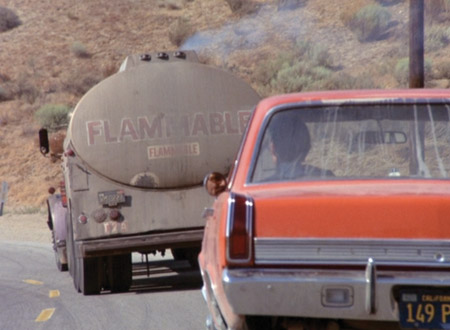
As was noted earlier, this is a film that involves a simple story. As David Mann proceeds on his journey farther into the desert, he encounters a big and slow moving oil tanker truck. The tanker is a disgusting monstrosity, and it is quite apparent that it has been involved in numerous battles, whether it be with the road or other drivers. The truck is shot in such a way as if to convey that this piece of machinery is a living entity. It is menacing, loud, and very overwhelming to Mann, considering Mann is driving a 1970 Plymouth family car. When the audience first encounters this truck, Spielberg voyeuristically surveys the entire body of the vehicle. As the camera pans from the back to the front of the behemoth truck, the audience is granted a glimpse at the beast that will be the cause of David Mann’s troubles from hereon out.  As the camera reaches the front, the audience also views many license plates (perhaps souvenirs from his victims). However, the audience is not allowed to see the face of the driver. He is the unknown stalking the unknown in a foreign land.


In Hollywood films, the desert has always been labeled as a survival of the fittest type of environment. Thus, there is a strong presence of masculine ideals existent within the outback (as is the case in many Australian films). How ideal that there is to be a battle of supremacy between a willing combatant and a man in desperate need to display some sort of masculinity for the audience.


The unknown has always been feared. In typical horror films, sensing and understanding that there is an evil presence is always much more terrifying then actually witnessing what the threat is. Your imagination is allowed to take over and create many disturbing and frightening visuals as a result. One of Spielberg’s key themes throughout his films is of the ordinary coming under attack from the extraordinary (think ‘Jaws’, ‘Jurassic Park’ (1993)). David Mann is an ordinary (perhaps ‘nerdy’) man, conveyed through his look, his car, and even his name. As he ventures into foreign land, he comes into contact with an extraordinary being, which is symbolized by the menacing presence of the truck.


After the initial introductions, it is time for the game to begin; and what a game it is. For the next 80 or so minutes, the audience becomes an unwilling voyeur in a sadistic game perpetrated by this relentless and menacing foe. Nothing will be spoiled for those who have not seen it, but it is definitely a ride to be experienced. This is a film that resembles the emerging creativity that Spielberg would quickly come to grasp and use towards all of his future films.


However, this film would not have been as great as it is if it were not for the truly remarkable performance provided by Dennis Weaver. He is basically the only character on screen, and thus he becomes our guiding point. The viewer identifies with him and, as a result, truly begins to understand him as a character. Fear, relief, paranoia, jubilation, and so on are all convincingly conveyed by Weaver. This is not an easy character to portray, but yet Weaver excels in his ability to create a character determined to survive.


This film is so simple but yet so intriguing and suspenseful. There are not enough words to describe the excitement this film helps to create. Though it was made in 1971, this film still packs quite a wallop. It is definitely a classic in every sense of the word.

An
Film Analysis,

Jaws: A Perspective


Thirty-five years ago, a young director, by the name of Steven Spielberg, overcame many obstacles to deliver a pulse-pounding adventure story bent on redefining the notion of fear.


Steven Spielberg has made a wide assortment of films over his nearly forty years in cinema. However, one continual theme has been persistent throughout most of his stories. As he has noted: “I’ve discovered I’ve got this preoccupation with ordinary people pursued by large forces”.


In ‘Duel’ (1971), an ordinary man is terrorized by a large, grotesque oil tanker. In ‘Close Encounters of the Third Kind’ (1977), a small community is visited by aliens. In ‘JurassicPark’ (1993), visitors are introduced to dinosaurs. Ordinary human beings and their relationship to all things extraordinary is a typical fixture of Spielberg films, and it is this thematic element which helps to formulate many memorable characters and situations.


In ‘Jaws’, Spielberg exploits this thematic issue to create a memorable adventure film, while simultaneously constructing realism through incredible, in-depth character development. ‘Jaws’, on the outset, is a film about a shark terrorizing a small costal community, but it is also a film that analyzes society’s preconceived notions about fear, courage, class, masculinity, and geographical displacement.


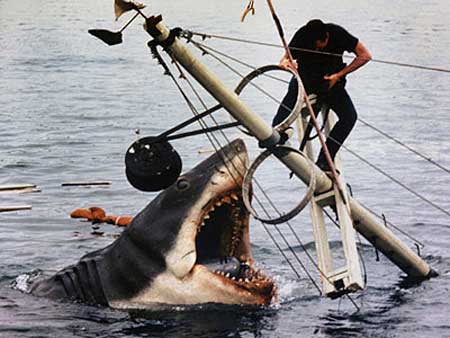
One key attribute exploited joyfully by ‘Jaws’ is in its refusal to provide a visual composition for its attacking offender. As an adventure/horror film, ‘Jaws’ succeeds largely on the basis that the audience rarely captures a glimpse of the shark. The fact that the audience cannot see what or who is behind the attacks highlights a fear and paranoia, which conveys so much more than if the shark were to be viewed on a consistent basis.


There has always been an unspoken fear concerning the nature of a faceless enemy in a foreign land. Man has always been deemed fragile in the face of nature and the unseen, which goes to highlight the fact that society has always feared what they cannot see, explain, or define.


Obviously, the audience is aware that a shark is perpetrating these attacks, but since they are unable to verify their assumptions creates an uncomfortable fragile mindset. In perhaps the most frightening use of camera work in cinematic history, there are many shots which occur from beneath the surface of the water, eyeing potential victims swimming above. The audience takes on the perspective of the shark as it moves closer and closer to its intended prey, while being prodded along by a wonderfully written score by John Williams. These people are unaware of a potential attack, but the audience has become fully aware of what is about to occur. The unknown being stalked by the unknown is perhaps the most frightening capability of film. The audience is left in a vulnerable and defenseless position.


The idea of terror is wonderfully exploited by Spielberg, and it is clear that he succeeds in filming these types of situations. However, the film has become a classic for more then what he has been able to incorporate visually. Where Spielberg truly excels is in his focus on characters and their relationship to the world around them.


‘Jaws’ is considered one of the greatest cinematic masterpieces of all time. This is largely due to the time and concentration spent on the nature of its characters.


The films protagonist, Martin Brody (Roy Scheider), is a complicated and less then ideal ‘hero’. He is a fragile character. In a way, he is very much like a child, insecure and lacking. He has relocated himself and his family to the tourist laden area of Amity, and has struggled to integrate himself into the defined boundaries of this community. He is as much a tourist as the conventional visitor is. He is a sightseer in a foreign land.


As shark attacks continue to mount, Martin is unable to arrive at any sort of solution as to how to put an end to the chaotic terror gripping this ideal summer haven. It is at this point that the film averts its focus from spectacle, and instead becomes a picture obsessed with the development of character relationships.


For reasons unknown, in the final third of the film, Martin decides (even though he is afraid of the water) to venture out onto a boat with the gruff, working class Quint (Robert Shaw), and the middle class intellectual, Hooper (Richard Dreyfuss), to not so much track down and kill this evil and maniacal shark, but as to achieve some sense of maturation for his own self-worth.


‘Jaws’ is as much a film about adventure and terror as it is about self-evaluation and self-discovery. These thematic issues are truly explored during the sequences between the three men on the boat. In typical Western films and Australian films (now in Spielberg films), there has always been a necessary contradicting theme present. That is, the idea that although wilderness (land, sea, etc.) and civilization (suburbia, the city) are two opposing thematic elements, they are nonetheless crucial to one another and to the understanding of these complex stories. These two ideas cannot coexist, but yet depend on each other to create tension and understanding.


As a result, Martin leaves the confines of a safe environment, governed by rules and authority, and enters an uninhabited sea defined by lawlessness and connoting a Darwinian survival of the fittest type mentality. The fact that Martin enters into this uncivilized land is reflective of the man Martin desires to be. His journey away from the familiarity of civilization will truly test who he is as a person and as an individual.


As was the case with the character of David Mann in ‘Duel’, Martin Brody will have to summon the courage and strength to survive, while struggling to maintain a firm grasp on his psyche.  He must learn to understand himself in an alien environment.


‘Jaws’ is a rich, methodically structured film that toys with its audience much in the way Alfred Hitchcock would toy with his. Spielberg seamlessly converts passive audience members into shockingly disturbed active participants. The film is filled with tension and delivers on spectacle, but should be remembered for its focus on character. An attribute which is sorely lacking in modern day thrillers.

AE
Film Analysis,

The Objectified Woman


Women have forever been linked to the idea of ‘bearer of meaning’ rather than ‘maker of meaning’ in Hollywood films. According to Laura Mulvey, author of the article “Visual Pleasure and Narrative Cinema”, women have forever been identified with the role of ‘passive observer’. As a result, men are permitted to live out their fantasies and obsessions by imposing them on the silent image of the woman. In basic terms, the male is identified as an active participant in the movement of the plot, whereas women have been typically assigned the role of inactive participant (she has no influence over the subject matter of the plot-she functions as a distraction for the male). As Mulvey has noted: “the woman’s visual presence (in narrative film) tends to work against the development of a story line, to freeze the flow of action in moments of erotic contemplation”.


The Objectification of Women


Women have rarely been respected inHollywoodfilms. Yes, there are numerous films about the empowerment of women and their drive and dedication for independence, but, for the most part, women have been relegated to the role of ‘eye candy’. They are rarely taken seriously and are usually vilified by the voyeuristic camera lens.


In typicalHollywoodfilms, men are in control of the gaze (that is, the audience sees what they see). Women are typically on the receiving end of that gaze. They are looked at, objectified and sexualized by the male protagonist. Women rarely have the power to reverse the gaze, and when they do, they are normally punished by the film’s narrative.


For instance, in Alfred Hitchcock’s 1963 classic ‘The Birds’ (a film about a group of birds that attack a small community), Tippi Hendren’s character, Melanie Daniels, is a strong, independent woman. When she first views Rod Taylor’s character, Mitch Brenner, she is intrigued. He has become an object for her satisfaction. She takes control of the gaze (not him), and as a result, he becomes objectified. As the film progresses, she becomes more infatuated with him and eventually proceeds to follow him on vacation. At one point, she is sitting out in a row boat in the middle of a lake, watching him from afar through a pair of binoculars. It is at this instant that the first bird attack occurs. There is no explanation as to why the birds attack in the film narrative, but if one studies it from a theoretical standpoint-one may understand that Hitchcock is punishing Melanie for attempting to alter the normal standards Hollywood has instilled for narrative film (In fact, if one studies Hitchcock’s filmography in detail, it seems as though he enjoyed reprimanding women for attempting to obtain subjectivity-Marion Crane in ‘Psycho’ is just one example). Melanie cannot be the maker of meaning (she cannot obtain subjectivity), but rather she must be forced back into patriarchal society’s defined role for her.


Subjectivity and Objectivity


Traditionally, this blatant representation of the sexes has consistently occurred throughout narrative cinema. However, in some instances, these two opposing factors have merged together and resulted in troubled representations of the female in question. In Ridley Scott’s 1979 film, ‘Alien’, Ripley (Sigourney Weaver) is the lone survivor of the alien attacks. Her entire crew has been killed and she has stood out as the subject of the film’s narrative. After successfully obtaining her subjectivity throughout the course of the story, the film begins to feel threatened by this idea and immediately (voyeuristically) objectifies her by showcasing her walking around in a state of undress. Instantaneously, her subjectivity is stripped from her and her role as object reemerges. In this one instant, the viewer no longer defines her as a subject. She is unwittingly undermining all that she has achieved during the course of the film. Yet, save for the final scene, Ripley is still an extremely strong character, and should be identified as a strong role model for women in film.


There are also many films in which women, desiring to be treated as subjects, have attempted to use sexuality to undermine the norms ofHollywoodnarrative. However, are they actually achieving this goal? No matter how much she accomplishes, if a woman is sexualized, isn’t that in some way undermining her role as a subject? Sexuality is a powerful tool, but is the woman still not being objectified as a result? If so, it is a shame that women are fooling themselves into believing that this type of sexual behavior will undermine the dominant ideology.


Conclusion


Hollywoodhas forever been built on illusion. As a result, many people are unaware of the dangerous portrayals of women in, not only films, but as well, magazines, television, and music videos. The idea that women are merely objects is an extremely wrong message to deliver to society. But yet, no matter how much one critiques or complains, women are still objectified in every form of entertainment. Sex sells and will forever be a strong selling point. Men have always been considered the maker of meaning in films, and as long as this continues, women will forever be objected to the voyeuristic gazes of the masses.


At
Film Reviews,

Swingers


Synopsis:


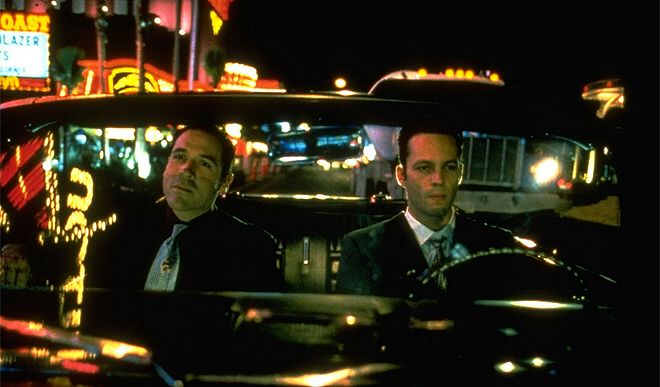
Mike Peters (perhaps the greatest character name ever for film), portrayed by Jon Favreau, is a wannabe actor who has moved out toLos AngelesfromNew York. He has recently broken up with his long time girlfriend, and is still devastated by it. Fearing the worst for his friend, Trent (Vince Vaughn), vows to do whatever it takes to get Mike back into the game, and proceeds to take him out to cocktail lounges, parties in the Hollywood Hills, and of course, Las Vegas to get his mind back on track.


Review:


‘Swingers’ is a film concerned with the heartbreak and torment of a love struck individual attempting to come to terms with who he is as a person.  From this vague description, one would assume that this film is about sorrow and loss. To tell you the truth, it is. But the films delivers it with such authentic sincerity that it becomes both humorous and humbling at the same time.


InHollywood, status is everything. Wealth, success, and geographical location are all crucial to this fundamental element of importance. In fact, a great representative of one’s own stature of significance inHollywoodis that the farther west one lives (from downtownLos Angeles), the more successful one appears to be. Mike desires success but has not yet achieved that status. As a result, he is relegated to inhabiting a dinky, unfurnished apartment in the heart of downtownLos Angeles. I guess he is east of success at this point. As a consequence, the films key thematic concern becomes firmly established. Mike is an outsider. He does not exist in this world. He is forced to quarantine himself within his apartment, and hide from this part of the world that has not yet accepted him.


In fact, Mike’s friend, Rob (Ron Livingston), is dealing with the same sort of upheavals.   Rob (having recently moved out toLos   Angeles) notes that back when he was inNew Yorktwo months ago, he was playing Hamlet in an Off-Broadway play. Now he is auditioning for the role of Goofy (to entertain customers around the theme park) for Walt Disney (in fact, later on, we discover that Rob fails to obtain this role because of his lack of theme park experience). During one crucial moment, however, Rob confesses that he only came out here because he was inspired by Mike to do so. To be honest, there are thousands of people each year who journey to Los Angeles in search of stardom, only to be cast away. As a result, these people become bitter and begin to question the dreams they had when they initially arrived in this ferocious town. These people feel alone and thus isolate themselves from one another.Hollywooddoes not care for the individual unless that individual can do something for them.


In a fit of despair, Mike weighs the option of heading back toNew York. He has all but given up.Los Angeleshas gotten the better of him. However, the character ofTrenthas not given up on him. He is determined to help Mike get back onto his feet and reestablish him as a member of society. Relentlessly, Trent proceeds to take Mike out to numerous establishments to show him that there is more to life then self-pity and self-loathing.


Trent, however, is not without his own flaws. He is a fun loving guy but he is all pizzazz and fizzle. His intentions are honorable but he has built himself up into something that is highly questionable. He believes that he has it all figured out when, in fact, he is as much an outsider as Mike is (Trentjust hides it better). This is greatly emphasized when Mike,Trentand three other friends head to a party in the Hollywood Hills. As they enter, everyone stares in bewilderment. They are not an accepted member of this status quo. It is a party for people who have made it. Not for people who desire to make it. Yes, Trent disguises himself as a member of this community and cleverly inserts himself within it (for a time being), but Mike is unable to do the same. Attempting to establish himself within this ‘important’ group, Mike proceeds to mingle with a female partygoer. The first thing she inquires about is the make of his car. When Mike confesses that he has a Cavalier, she turns away in disgust and ignores him. He cannot fake his way into this world because he is not yet fit to be a part of this world (not yet, anyways).


Given the serious tone of this review thus far, ‘Swingers’ is in fact one of the most hip and fun films of the past twenty years. The characterizations are realistically well drawn, and the vocabulary enunciated by this group of friends is fresh, intriguing and memorable. They discuss issues that are non-important to some, but relevant to others (Discussions about the tracking shot in ‘Goodfellas’ (1990) and the slow-motion opening of ‘Reservoir Dogs’ (1992)-which are both reenacted in the film), and they have interesting modes of speech and communication (Vegas Baby, Vegas), (Baby, you are so money, and you don’t even know it!). In fact, the language can be characterized as normal typical banter spoken amongst any group of friends concerned with discussing the nature of popular culture (highly reminiscent of ‘Seinfeld’). These people could be any one of us and the film whole heartedly embraces this fact.


One of the key contributors to the overall effectiveness of this film is in its use of music. Many vintage crooners are nostalgically revisited here (like Dean Martin), while simultaneously incorporating swing music through the likes of the band, Big Bad Voodoo Daddy. Swing music is an important element for this film because it gives the film life. It helps to destroy the self-pity of Mike, and awakens him to the possibilities of hope (it plays an important part during the last twenty minutes of this film). The films somber subject matter is undermined by the up-beat nature of this vibrant genre of music.


Sincerely, ‘Swingers’ is not a film that attempts to sadden the viewer. It is here to rejuvenate the tortured soul, and to reestablish the battered human psyche. The important element here is the value of friends. No matter how down and out one may be; true friends will always remain by your side. In fact, Mike’s trust in his friends helps him to reemerge as a member of this alien society. Yes, there are many embarrassing modes of dialogue, and one extremely unsettling sequence with an answering machine for Mike (perhaps one of the most difficult scenes to watch in film history), but he is able to bounce back from his humiliation.


‘Swingers’ is an extremely low budget film ($250,000 to be exact), but it never lets its budget constraints prevent it from being what it truly wants to be. It is a film with heart and soul, and deserves to be categorized as one of the greater buddy films of all time.


As
Film Reviews,

Se7en


Synopsis:


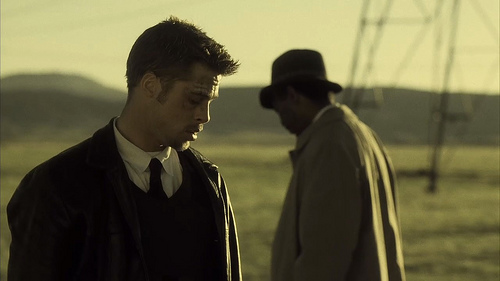
Two detectives, Mills (Pitt) and Somerset (Freeman), race against time to thwart the attempts of a serial killer, who chooses his victims according to the seven deadly sins.


Review:


Greed, sloth, envy, pride, wrath, gluttony, and lust are just some of the highlights the viewer will be exposed to in this bleak, unrelenting, neo-noir nightmare of a film. This film wallows in the excessive impurity of a world gone astray. It is not a happy film; in fact, there is not even a happy ending. Instead, for two hours, the viewer will be witness to the very atrocities and vile indecencies this world is capable of.


This film is dark; oh boy, is it ever. It is an unsettling depiction of a world that is out of control. In fact, at one point in the film, Somerset notes that he no longer understands this world, and later on when asked how long he has lived in the city, he wearily replies: “too long”. This world has gotten the better of Somerset. He is retiring in seven days, but that will not allow him to forget about the evils he has encountered during his time in this urban hell of a city (that is never named during the length of the film).


When the character of Mills arrives on the scene, Pitt plays him as idealistic and ambitious, but yet naïve. In fact, he comes across as cocky and rude in some instances. The two characters of Somerset and Mills are polar opposites of one another. One a father figure, in a sense, attempting to shield the other from the evils he has encountered. In fact, in one instance, Somerset mentions to the chief of police that he does not believe that this should be Mills’ first assignment. Mills sees it as an insult, whereas Somerset understands that Mills is not psychologically ready for what he is about to encounter. It is an old fashioned case of experience and weariness versus ambition and innocence.


This is not a violent film but yet it seldom lets the viewer off easy. Gruesome and graphic, the film can be read as a statement on modern day angst and loss of place and understanding in an ever changing world. People want to escape this city but yet no one seems willing enough to leave it. Is it because this film is attempting to state that no matter where one goes, one will always be subjected to this type of visual and mental anguish? In other words, everywhere in the world is reminiscent of this city. There is no escape.


David Fincher and his director of photography, Darius Khondji, paint a miraculous picture of a world darkened by the evil that lives within the realms of the human soul. Through low contrast lighting, silver colored rain during a rain storm, and the removal of any form of key lighting, they are able to achieve the idea that this city is dead. The city is devoid of any kind of primary color to help bring life to it. It is only in the last twenty minutes that the audience witnesses a sunny day, but that is viewed from outside of the city (on the way to the stunning and unbelievable climatic moment the film has been building towards throughout). The use of lighting is extremely atmospheric and, in a sense, helps to establish the city as another key character in the film. The city is alive, but yet is slowly decaying from within.


One cannot conclude the review without mentioning one of the most vile and despicable (yet intellectual) serial killers in film history. John Doe is methodical and patient. He does not kill on emotion, but rather feels that he is a messenger summoned to destroy the wicked. He is evil, but yet the great actor that portrays him (his name will not be mentioned in case anyone has not seen the film) creates a character that is just that, a true character. In others hands, John Doe would have come off as merely a one note serial killer. But yet, Doe is given tremendous depth and development. This is in large part due to the script (he is one of the better written killers in recent memory), but it is truly brought to life through the actions and mannerisms of this actor.


This film is not for the squeamish but yet if one wants to witness acting at its finest (actually, there is one key moment at the end involving Mills that just does not seem to work), a script that is taut and tense throughout, and assured direction, then one should do themselves the favor of watching this film. As was noted earlier, this is in no way a happy film, and there is very little action (it focuses more on the investigation side of it all), but yet it is never boring. The characters are smart and they act and speak in accordance to who they truly are as human beings. Everyone has a point and they are allowed to share that point within the film. They say what they feel in an honest manner. They believe in their words and actions, and that is what makes them reliable characters. The audience truly believes that these characters are who they say they are.


Fincher’s Se7en is a modern day masterpiece. It is dark and unrelenting but it whole heartedly embraces the darkness it presents. It is also a film that helped to regenerate  interest in the serial killer genre once again, and led to the release of other, less than satisfactory films (exploiting the success of Se7en), like Kiss the Girls and Along Came a Spider.


As has been said, this film is an unnerving adventure and strives to delve deep into the realms of one of the vilest criminals in film history. Yes, it is sometimes difficult to watch but yet it is impossible to turn away. That is the definition of brilliant filmmaking.


AE
Film Reviews,

Robocop


Synopsis:


After being murdered by a ruthless gang of criminals, Alex Murphy (Peter Weller) is resurrected as a crime-fighting cyborg named ‘Robocop’.


Review:


Albert Einstein once said that: “It has become appallingly obvious that our technology has exceeded our humanity”. It is a very true fact indeed that technology has become an unstoppable entity. It is ever-growing and constantly on the move. It has strived to make our lives easier, but has managed to gain the reputation as a slave master. We, as society, have become enslaved to the very idea of technology. It has taken us over and has rendered us vulnerable to its’ utopian ideals. Some of have said that it has stripped us of what many hold dear to them; our humanity.


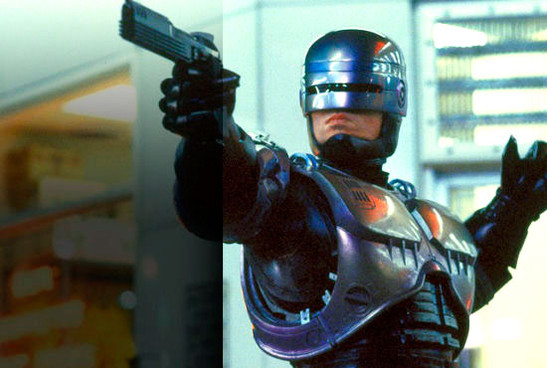
‘Robocop’ is a film that does much more than entertain. It strives to understand the relationship man has with technology/machine. The fact that Robocop is a man controlled by technology is a statement unto itself.  Even the title of the film is a hybrid of two opposing factors; man and machine. After being systematically slaughtered, it is only through the power of technology that Murphy is allowed to live once again. However, as a result, technology has rendered him a thoughtless and emotional free being. He is mundane and computer like in his speech, and his suit is highly symbolic of the cold/sterile and colorless world that technology represents.


‘Robocop’, on the surface, is about his role as a crime fighter, striving to uphold the law no matter the cost. But on a much deeper level, the film is about his personal conflict with the technology that now controls his body. Throughout the course of the film, Robocop attempts to retrieve some evidence of his once prevalent humanity. When he first became Robocop, all his memories and emotional content were erased, thus making him an invalid without the proper guidance of human beings. It is only through a relapse and his quest to regain his old self that the audience begins to realize that man cannot always control technology. It now has the ability to control us.


Robocop soon begins to act irrationally as he begins to have dreams, memories and thoughts (He is now beginning to retrieve some of the individual characteristics that made him human in the first place). The scientists governing him have no idea what has happened as they are no longer able to control him. In one telling scene near the end of the film, Robocop removes his mask and fights without it, revealing the face of Murphy. It is a very shocking sight since Murphy’s human face is fused with the mechanical properties of a machine. The very fact that he begins to speak, think and feel as a human once again during this sequence represents his quest to separate himself from the machine that is now in control of him.


Paul Verhoeven, in his second American film, presents an idea that technology can be understood as a major threat to our very own civilization. Many scenes, in which Robocop or Ed-209 (one of Robocop’s many adversaries) appear, strongly depict the failures that technology is capable of. In one particular scene, Dick Jones (Ronny Cox) is presenting the new and improved machine crime fighter, Ed-209. In a demonstration, one of the business men in attendance is told to point a gun at Ed. He does so and the machine tells him to drop it. The man relinquishes the weapon, but the machine continues to warn him. In the background, scientists scramble to fix the problem, but it is too late. Ed-209 opens fire and massacres the man to death with automatic weapons. It is an undeniable statement that technology which cannot be controlled by man is capable of decimating humanity to the point of extinction.


‘Robocop’ is very strongly-opinionated. On top of critiquing technology, it also has much to say about society, politics and commercialism. With that being said, the film is also a solid form of entertainment (It is a must-see for action buffs). It is very violent and unrelenting in its brutality, but it does manage to tell a cohesive story.


Looking back at it, ‘Robocop’ is a very undermining film. There is a lot more going on than mere action-filled sequences. It is a highly subversive piece of work, and manages to illicit many reactions as a result.


*Humanity is acquiring all the right technology for all the wrong reasons.  ~R. Buckminster Fuller