a999l
Music, Music Reviews,

Seether Live Concert Review

Date: May 26, 2011

City: Toronto,ON

Venue: Opera House

Rating: 4/5


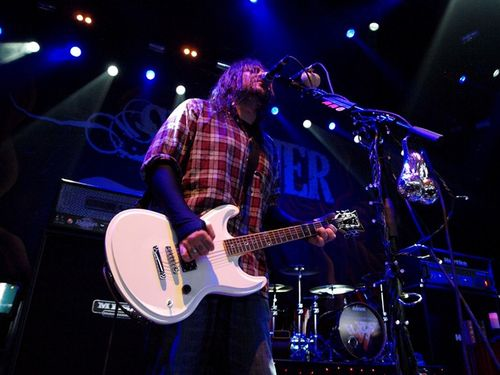
If you like your rock n’ roll immersed in grimy filth, the Opera House was the place to be Thursday night. Devoid of pretentiousness, South African rockers Seether skillfully adhered to a back-to-basics sort of rock. Loud and ferociously abrasive, the jam-packed audience was sonically assaulted from the very first guitar riff.


Though the set was a mere 13 songs with no encore, Seether accomplished what they set out to do; entertain a crowd foaming with rabid intensity. From the opener “Gasoline” to closer “Remedy”, the raucous crowd passionately embraced the essence of what a rock n’ roll gathering should be. With total disregard for personal safety, multitudes of bodies were repeatedly propelled above the outstretched hands of the frenzied audience with careless abandon.


Feeding off this energy was a band who simply wanted to rock. Talk is cheap, and Seether barely said more than ten words throughout the entire evening. But who desires words when a guitar, a bass and a drum kit have the ability to express so much more.


Crisp-sounding and tight throughout every song, Seether performed many of their hits including “Broken” (acoustically), “Fine Again” and new single, “Country Song”. Having also been largely inspired by Nirvana over their career, the band even covered the grunge-rockers “Heart-Shaped Box” with staggering success. Not too many singers can match Cobain’s intensely emotional vocalization, but Shaun Morgan’s unbelievable voice (as powerful as it can get) paid homage with booming ferocity.


But not everything was pristine. Though Seether has been known to play very short sets over their career, the concert seemed to conclude rather prematurely. Just as the energy in the building was gaining in intensity, the show was suddenly over. Many were left surprised and looking abandoned without any intuition as to what to do. There were futile attempts to await the return of the band but to no avail. Without an encore, the congregation filed out ontoQueen St.impressed, but secretly sulking for more.


Apart from this and, of course, the obligatory drum solo that was conducted during the performance (which has grown tiresome over time- no matter how talented the solo may be), the show entertained. Simple and straightforward-the way a rock concert should be.


a99k
Music, Music Reviews,

The Airborne Toxic Event Live Review

Date: May 13, 2011

City: Toronto,ON

Venue: Opera House

Rating: 3.5/5


Audience indifference can have quite an effect on the energy of a performance. No matter how talented a band may be, a weak spectatorship has the ability to undermine even the most entertaining show. Friday night’s performance by the Airborne Toxic Event at the Opera House was threatened, at times, by this very act.


As I walked into the sold-out venue prior to start time, I instantly became aware of a feverish anticipation possessing the room. There is no denying that sort of sensation. The concertgoers were laughing and yelling with an unbridled enthusiasm, keenly aware of impending bliss. I realized that this show was going to be fully charged.


But then something enigmatic occurred. As soon as the show commenced, the audience immediately mutated into a congregation of listless observers who were seemingly content with simply staring back at a band striving to entertain (they were sporadically jolted awake by the opening two tracks “Numb” and “Wishing Well”, but it quickly subsided).


The heavily intoxicated gentleman next to me even noticed this abnormality. Observing me jotting down some notes, he staggered over, put his arm around me, and began to speak with the echoing presence of an infant, “What are wrong…with the people? Where’s the dancing? They does not move…they just standing…doing nothing. Th…is band rocks!” Though I was distracted from two songs as a result of this marble-mouthed individual, I did wholeheartedly agree with his hazy assessment.


However, around the midway point of the performance, the audience resurged with a vengeance. As the band broke into some of their more popular songs like “Happiness is Overrated”, “Changing”, “Welcome to Your Wedding Day” and “Sometime Around Midnight”, the audience morphed into energetic cheerleaders. Raising their hands to the sky and bounding around with reckless abandon, the show was instantaneously transformed into the event I had prematurely believed it would be throughout its duration.


Even the band was influenced by the sudden alteration in atmosphere. Earlier in the show while talking to the crowd, singer Mikel Jolleet had to stop what he was saying and confront a portion of the audience who seemed preoccupied with conversing loudly with one another. Humorously, he noted, “There’s a single’s bar next door if you guys are interested”.


From that moment on, the audience belonged to the band. As if spurred on by a new found zeal, Jolleet twice leapt into the crowd to sing amongst them (during “Something New”, he even ascended atop one of the bar’s and sang a duet with fellow band member, Anna Bullbrook, who remained on stage). Apparently influenced by Jolleet’s gallantry, Bullbrook herself dove into the crowd and proceeded to play the viola while moshing. It’s safe to say I have never witnessed an act quite like it before.


Though there were a few sonic irregularities that occurred throughout the night (Jollett’s guitar wouldn’t work on “Papillon” and had to be replaced mid-song), the band’s passionate display of their talents compensated for the few lackluster moments. Even when the show concluded, the band members didn’t immediately vacate the stage. They took the time to take pictures and chat with their fans, who they constantly thanked throughout the evening. It was a highly admirable act that redeemed a night initially jeopardized by apathy.

a99f
Pop Culture,

The Beatles Are Evil (For Now)

We live in a bubble. The bubble we inhabit is defined by particular codes and regulations of how society is to properly conduct itself. Because our cultural and social norms are pre-determined from birth, behaviour that does not assimilate itself with these pre-established values is typically deemed as opposing what is morally correct. Inhabitants of society are considered to act in a particular fashion, or be deemed as dangerous opposition to social values.

It’s often funny how we adapt our behaviour to the defined values governing our particular culture. If I’m acting selfish, I am certainly going to be questioned about it by my peers. Being selfish may be who I am as an individual, but being selfish is also deemed as an inappropriate behavioural trait that needs to be regulated. In a sense, certain qualities define us as individuals, but if they are deemed inappropriate by our peers, we force ourselves to change and conform to our socially predetermined values*.

It is only when mainstream culture finds some way to define ‘other’ behaviour that it becomes acceptable and thus categorized as safe.

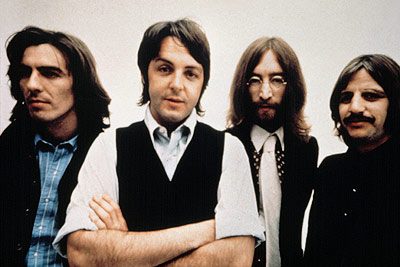
In regards to popular culture, society has always struggled to cope with alternative modes of thought. Whether it was found in the gyrating hips of Elvis Presley, or in the long, social misfit haircuts of The Beatles, society has struggled with evolution. In 1967, Arthur Penn’s ‘Bonnie and Clyde’ depicted graphic violence never before seen in mainstream film. From 1971-79, ‘All in the Family’s’ Archie Bunker proudly expressed his bigotry to weekly audiences. Sexuality was pushed to the limits in Bernardo Bertolucci’s ‘Last Tango in Paris’ (1972), which saw Marlon Brando and Maria Schneider realistically** portray the act of fornication to art-house audiences worldwide. In the 90s, Marilyn Manson screamed about his love for the devil, and the 2000s were highlighted by Eminem’s lyrical onslaught viciously directed towards his wife and mother***.

The point of this article is not to condone nor condemn these particular moments in popular culture history. Rather, it is an attempt to point out how particular actions not immediately understood by society were deemed amoral and socially inappropriate. These actions did not fit within the bubble of mainstream culture. Our particular way of functioning has rules, and this behaviour found in music, film, or culture in general opposes rules. They were pushing the envelope of what was deemed acceptable.

As mentioned prior, it is only when society allows itself to adapt and expand its understanding of what is acceptable that this sort of behaviour becomes flavourless and deemed safe. Thinking about it today, is Marilyn Manson still controversial? Maybe yes, but largely No, and it’s because society has engulfed him into their sense of cultural understanding. Because they have allowed themselves to open their minds, his behaviour is not as startling as it was back in the mid 90s.

In regards to the violence in Bonnie and Clyde, it is now considered tame in regards to what films now depict. And thinking that Elvis and The Beatles were ever controversial is actually quite amusing nowadays, but back in the 50’s and 60’s, society was shocked by such behaviour. In order to compensate, they had to adjust and learn to accept it for what it was. You see, society will always find a way to adapt, and once they do, outsiders will always be tamed.

But as it is a continuous pattern, every so often, someone or something will attempt to exert force against the ‘what is deemed acceptable’ barrier. And through our eventual acceptance, the bubble we live in will continue to expand at an excessive rate, and will forever do so. Nothing remains controversial for too long****.

*On a daily basis, the qualities that define us as individuals are criticized by others for their inability to gel with our social and cultural norms. Ideas and behaviour that are misunderstood or deemed foreign to a culture’s dominant ideology are immediately deemed as dangerous and misunderstood.

** To this day, audiences are still unsure if the sex was actually simulated or real. In fact, there are still rampant rumours that indicate that the sex was actually real. BUT, I have read a few articles that simply state that these rumours are false. So, in retrospect, I have come to no conclusion on this topic.

***There are far more examples, but I think you get the point. Controversy, like breathing, has become a staple of popular culture.

****Many individuals know that being controversial is a wonderful marketing tool to gain popularity. Any publicity is good publicity. Why did Marilyn Manson stand out in the 90s? Because he took a taboo topic like devil worship and brazenly shoved it into mainstream culture’s face. As well, Eminem is merely a character created by Marshall Mathers. Eminem is an alter ego, and commits unsavoury acts that are highly controversial (this duality is an interesting topic to discuss in a future article), but they are controversial because they exist outside of the social bubble. If you notice now, Eminem is not deemed as dangerous as he was back when he first emerged as a mainstream artist. Society now understands him. Eminem and Manson are now situated firmly within the bubble of mainstream culture. But soon, some other act will be introduced to make our jaws drop.


abc
Pop Culture,

‘Rocky 4’, Good (Communism, Bad)


After watching ‘Rocky IV’, one thing is clear to me-Rocky Balboa should be employed by the UN as a peacekeeper. Though the man is capable of taking action when necessary, it’s his gift for gab that has nations disposing of their belief systems.

Case in point

At the end of ‘Rocky IV’, Rocky and Ivan Drago (The ‘evil’ Russian boxer) have just completed an epic 15 round battle that has seen Rocky come out on top as victor. The match has taken place in Russia during the reign of Communism. They haven’t liked Rocky from the start, nor have they cared for his wild, fun-loving American ways.

But we know better. We know that he will change them, because that’s the right thing to do, isn’t it?

Rocky, on the other hand, is not here to initially make friends with the Russians. He is here to avenge the death of Apollo Creed, who was killed by Drago in a boxing match in Vegas (I believe he had it coming, since Apollo flamboyantly came down to the ring dancing and singing to James Brown’s ‘Living in America’-I’m surprised Russia didn’t revoke our vodka privileges after this outrageous incident) . But anyways, Rocky wants vengeance, and of course, he gets it done. But inexplicably, during the course of the match, the Russians begin to cheer for Rocky. Now correct me if I’m wrong, but I believe turning on your country in favour of your opposition is a big mistake (As I remember it, America and Russia were not close friends in 1985). Think about this in another context-If you’re Canadian, and Canada is facing off against the United States in a hockey championship game, would you really begin to side with the Americans simply because they have shown heart and perseverance? Highly doubtful.

But it doesn’t end there. As a result of these Russian Benedict Arnold’s, Rocky takes the microphone after the fight, and decides that he can further persuade these people to vote America.

Here is what Rocky says to the Russians:

“During this fight, I’ve seen a lot of changing, in the way you feel about me, and in the way I feel about you. In here, there were two guys killing each other, but I guess that’s better than twenty million. I guess what I’m trying to say, is that if I can change, and you can change, everybody can change!”

Immediately after this Martin Luther King-esque speech, the Russians are unable to contain their emotions, and rise to their feet with applause.

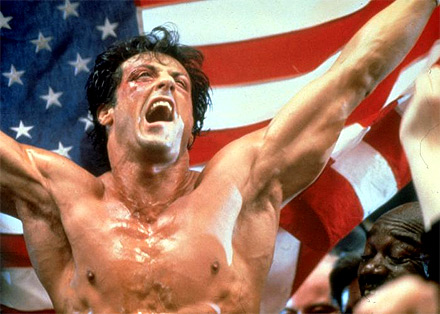
So let’s get this straight. Communist Russia has resisted interference from American government institutions for nearly three quarters of a century, but when they encounter an American boxer, they cannot resist his simplistic views of world peace. Even better is the fact that after Rocky sells this peace to the Russians (after beating their champion), he has the audacity to flaunt his American flag in the Russian ring like he’s eating a burger in front of a starving child. But of course the Russians are not mad. They continue to applaud his insensitivity to their cultural norms. Even their government stands up and applauds, which basically states “You know what, even though Communism has been our cultural ideology since 1912, we have made a mistake…Thank Goodness that Rocky fella showed up and opened our eyes”.

Strangely, Communism in Russia was abolished in 1991, just six years after Rocky IV was released. Hmm, maybe Rocky was onto something.

*Of note, the beginning of Rocky V starts immediately after part 4, and depicts Balboa suffering from the early stages of brain damage. Perhaps the Russians shouldn’t have taken him so literally.

a99g
Pop Culture,

The Importance of RockStar Games

Rebellious. Controversial. Aggressive. Fearless. Anti-Authority. These are but some of the characteristics that help to define the role of the rock star in modern day society. Rock stars are unafraid to push the limits of an established set of rules. They constantly question authority and live to upend the social structures that help to define it. Their belief’s become their passions, and they strive to share these with the surrounding world. Their aura is intoxicating and inspires others to follow their way of life. This is the life of a rock star. This is the unofficial motto of Rockstar Games.


The Influence of Grand Theft Auto


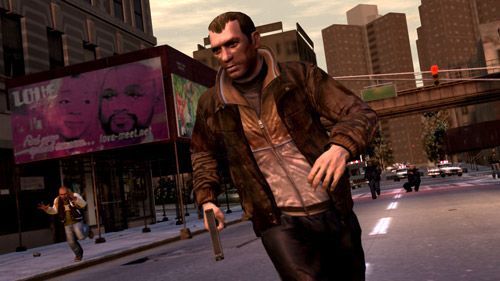
It is quite difficult to imagine that anyone is unaware of the modes of entertainment developed by Rockstar Games. To be quite honest, the company has formulated a solid and definitive identity through its games, and their influence has reached staggering levels as a result. The Warriors, Red Dead Revolver, Manhunt, oh yeah, and something called Grand Theft Auto (GTA) are just some of the titles that have been released under the Rockstar name. These games are extreme and in some critics’ eyes (government officials, religious groups and parents), they have come to represent a decrease in established rules and moral codes. In other words, they have pushed the limits of what has been deemed acceptable by society. However, it is impossible to ignore the influence some of these games have had on the gaming world. Without Grand Theft Auto, would there even be games like The Getaway or The Godfather? Would The Warriors or Manhunt ever have been conceived if it were not for Rockstar Games and their Grand Theft Auto series?

Rock stars are uninhibited. They don’t follow the trends; they set the trends. People come to admire their work and try to emulate it somehow in their lives. The same can be said for Rockstar Games. Other companies, desperate for a mega-hit, witness the unbelievable success of the Grand Theft Auto series, and begin to envy the recognition the games receive. As a result, similar games begin to emerge on the market and exploit the popularity of the GTA name. As it is with any entertainment medium, the success of one creates many doppelgangers. Games such as Saints Row and True Crime: New York City, are clearly inspired in terms of style and game play by the GTA series.


The Importance of Grand Theft Auto


The Grand Theft Auto series has created countless imitators, some good and some bad. Rockstar Games had extreme faith in this series and put a tremendous amount of effort into rejuvenating the video game industry in 2001 with the release of Grand Theft Auto III. The game changed the way games would forever be played because of the amount of detail involved. The game had it all. It was a crime game, a racing game, a strategical game. The best thing about the Grand Theft Auto III was not its main or side missions but rather its gift to the gamer of allowing one to roam freely around the video game environment provided. One could go anywhere; do anything without affecting the storyline in anyway. This was a new wave in video game artistry. This was the breath that possibly saved the video game world from imminent death.


The Controversy of Rockstar Games


However, there are some that find Rockstar Games highly influential in other, not so positive ways. To some (government authority figures and concerned parents), Rockstar promotes violence, sexual attacks, debauchery, theft and lust. To be honest, Rockstar Games do include many adult oriented themes not intended for children. These games are rated M for Mature for a reason (ESRB rating system). The violence is extreme, as is the case in Manhunt. The sex is indecent, as is the case in Grand Theft Auto. The point is, is that Rockstar Games is attempting to push the limits of what is deemed acceptable by society in the present day. They don’t merely do this for their own personal gratification but rather to challenge and question the rules that are deemed justifiable by the higher ups of society.

Anything innovative that is not confined within the walls of acceptable behavior has always been deemed inappropriate and anti-establishment. As a result, controversy has always existed in relation to all forms of art. In the films Bonnie and Clyde (1967) and Midnight Cowboy (1969), both strived to push the limits of violence and sexuality, respectively. This was a new era that strived to do something different. Controversy is still seen today in films such as Pulp Fiction (1994), The Matrix (1999) and Saw (2004). In music, Eminem and Marilyn Manson were deemed controversial and blamed for many violent crimes, like the Columbine shootings. These were not artists that attempted to conform and thus were labeled as indecent and amoral. To be confined is to be constricted in movement, in thought, and in free will.

There is no way to prove that violence in video games has anything to do with violence in the real world. It’s an easy cop out by government officials to solely blame the media when there are so many other factors at play. Rockstar Games is important to the industry; they strive to work outside the box by attempting to challenge society’s established rules. There are more extreme games out there in regards to violence and sexuality; however, Rockstar Games have strived to clearly identify themselves as a pioneer in this market. Without Bonnie and Clyde, how would film critique the use of violence in cinema and its relation to society? Without All in the Family (1971-1979), would television be as open minded to the issues surrounding race and politics?


Conclusion


Where would culture be without controversy and change? To evolve is to constantly change. Rockstar Games is a true representation of transition in the video game industry. Not because it promotes indecent behavior, but rather because it cares about the industry and its future. Change was needed in the industry and Rockstar Games stepped up. The rebel of the video game industry, Rockstar Games truly lives up to the name.

a99h
Pop Culture,

He-Man Loves…Himself

A Classic Study in Narcissism

A narcissist is described as being excessively preoccupied with issues of personal adequacy, power and prestige. A narcissist complex typically leads to a Narcissistic Personality Disorder (NPD). As defined by the NPD, narcissism is usually linked to a pervasive pattern of grandiosity, a need for admiration, and a lack of empathy.

My goal as a writer is not to identify and attempt to offer a solution to the many individuals suffering with this disease. Rather, I tend to focus on this issue and apply it to particular television shows I have grown up with. Sound strange? Good, that’s the whole point. Plus it’s really, really entertaining to analyze things that are not meant to be scrutinized under a microscope.

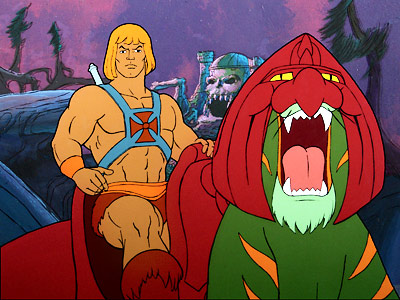
In regards to my focus on narcissism, I can find no one better to fit the bill than a character who has self-proclaimed himself, “The most powerful man in the universe”. For those of you who don’t know, I am talking about He-Man and his ‘Masters of the Universe’ television program from the 1980s. The television writers may have you believe that He-Man is fighting for democracy in his homeland (the fictional planet of Eternia), but in reality, he is a closet narcissist (and a bit of a fancy boy if you ask me).

Though He-Man doesn’t display every personality trait/tendency typically associated with NPD, his actions are quite troubling. First off, his clothing attire is mind-boggling. He-Man wears some sort of shorts concoction around his midsection, while his top half is covered by a very flimsy looking breastplate. In my understanding of it all, He-Man desires very minimal clothing in order to accentuate his overly-produced (chemically assisted?) masculine features. His choice in attire clearly identifies a complex. Instead of properly protecting himself during battle (from swords, arrows and magic), He-Man desires (demands?) to be the centre of attention. How else can you explain that mostly every other warrior in the program episodes wears proper battle gear (or some sort of attire that helps to protect the body?) Just compare He-Man’s wardrobe with Man-At-Arms, one of his loyal sidekicks, and you will see the light. You know, just because he believes that he is the most powerful man in the world doesn’t mean he should dress like he knows it. Strike one.

I have noticed that He-Man always has to be the hero. In fact he craves the spotlight, and this is readily apparent because every time he accomplishes a task, he feels the need to call attention to it. Case in point-in one particular episode I was watching entitled The Deflection, He-Man and his friends are attempting to find Gorgon, one of the many evil creatures that inhabit Eternia. When Gorgon blocks all of He-Man’s entrance ways, he believes that he is safe from apprehension. Gorgon’s arrogance is only overshadowed by He-Man’s insatiable lust for himself and his abilities. In one instant, He-Man bashes a wall down with his fist, and then in a cocky gesture (waving his hand forward as to say, ‘Was there ever any doubt?’) ushers his non-believing friends through the wall. In another instant from the same episode, He-Man destroys a door made up of steel (of steel!) with one punch and one dose of overt egotism. There is no suppressing the inflated self-image of this ‘so-called hero’. Strike Two.

For those of you who don’t know, He-Man is the alter-ego for Prince Adam (He-Man’s real name). An alter-ego is usually created as a result of a person’s insecurity with their own identity. So what better way to identify the love you have for yourself than to create a persona that identifies you as the most powerful man in the universe? In keeping with this, why even have a team of warriors? If you are who you say you are, then a team is unnecessary. This again goes back to the idea that He-Man needs an audience to congratulate him when he succeeds. I think my friends would get very tired of me if I constantly said I was the best at everything.

So, my question is this…if he is the most powerful man in the universe, why can’t he just bring freedom to Eternia? Well, the answer is quite clear, my friends. If he did that then there would be no other way to show off his amazing physical features. His high in life comes from situations that seem impossible to endure. When his sidekicks are at a loss of what to do, he always steps in and solves the situation. His goal is not to merely answer the problem emphatically through the use of violence, but rather to receive positive reinforcement/ acknowledgement from his peers. He needs the attention because his ego demands it. His deep insecurities are readily apparent as a result of his whorish ways. In a sense, he is an exhibitionist.

He-Man may want the best for his land, but at what price? Is he still a hero when his motives are self-congratulatory? Even his name, He-Man, is a very narcissistic man’s man sort of name. Why can’t his name be Kenneth or Julian? It’s because those names are too common. He needs to stand out, and as a result, his narcissism accelerates to the surface. So, who is the real enemy here? He-Man’s foes or himself?

You may have fooled me as a child, He-Man, but as I have aged I have seen the errors of your ways. You are a juice-head who cares only about the perfection of his own body (oh, and to constantly proclaim to your friends that you are the most powerful man in the world). Someone really needs to knock this guy off his high horse. Go take another steroid, jerk! Strike three, you’re out.

a99i
Pop Culture,

The Things That Didn’t Make Sense About Our Favourite Childhood Programs

There are many aspects of our existence that I will never understand. I will never fully comprehend neuroscience, nor will my brain gravitate around the concepts surrounding astrophysics. Perhaps more importantly, I will never understand why Tango & Cash and Road House are not considered two of the greatest films of all time (perhaps one day I will discover the truth behind this particular enigma).


To be truthful, the fact that I will never be an expert on these subjects does not necessarily bother me. However, what does perturb me has a lot to do with popular culture, and more specifically, the television programs I watched as a child. There are moments that occurred during my favourite television shows that I never once thought were bizarre or out of the ordinary. Why I have decided to analyze these glaring errors now, I may never know. There are many more important issues out there to discuss, but these I feel do not need to be addressed at the current time. So, without further due, here are my grievances with late 1980’s and early 1990’s television (or better known as the events that helped to shape a large portion of my childhood).


‘Saved by the Bell’ and Science


Zack Morris is the most powerful entity on planet earth. Forget about Bill Gates, Barack Obama, and even Mother Nature. These are all examples of powerful individuals/ forces, but there is one thing that these men/entity will never be able to do: To have the power to manipulate and halt time with two simple words- ‘Time Out’. For those of you who were avid viewers of Saved by the Bell, remember when Zack, during moments of great crisis, could just stop and turn his direction to the camera off-screen and vocalize these two powerful words. In an instant, everything present in the environment he was placed in would come to an immediate stop. Yet, he had the power to move around, manipulate, and alter the very aspects of the reality he was presently associated with. How, I will never know, but that is a power that I am extremely envious of. Think of the possibilities (But I digress).

So, in retrospect, how is it that I never thought this moment of the show was out of the ordinary. I mean, it was hard to define Saved by the Bell as a realistic interpretation/depiction of high school life, but at least the moments of the show remained in a realistic context. How a high school kid had the ability to challenge every single law of time, movement and speed is beyond cognitive comprehension (I wish Stephen Hawking would get around to addressing this issue).

Why this issue is so bothersome to me at the present time is beyond any valid suggestion, but one day I would like to sit and chat openly with anyone who may have a suggestion to this meaningless conundrum that has baffled me for over 15 years now.


‘G.I. JOE’ and The Inadequacies of Modern Warfare


I will keep this short and sweet. The two opposing forces in the television show, G.I. Joe and Cobra, were supposed to be the greatest military men around, correct? They were the best of the best (yes, even better than Eric Roberts). One was fighting in favour of society’s freedom; the other was working towards the decimation of that democratic freedom (and the ability to control civilization’s best interests). Though my definition is fairly simplistic, this was the basic summary of every G.I. Joe episode. Sounds reasonable, doesn’t it?

Well, if these two opposing forces were the epitome of what it means to be the best, then I am truly frightened. Why am I frightened? Well, for the simple fact that neither of these two armies were ever able to hit a bloody target. Not once, in all my years of digesting the visual diarrhoea that is G.I. Joe, did I ever witness a casualty of any sort. Now I know that you are thinking that the reason for this was because the show was aimed squarely at children, and that there couldn’t be any sort of inflicted punishment perpetrated on screen. This fact does make sense. But, with all of those blue and red lasers propelling through the air, you would think that someone would eventually receive some sort of a flesh wound. But alas, this sort of incident never occurred. So I ask of you, the viewer/reader, would you really want G.I. Joe fighting for your freedom?

Think about it. If the thousands of lasers zooming through the air aren’t hitting opposing soldiers, then who are they striking? Yep, you guessed it, innocent bystanders. You, me, and your friends could all be decimated by the alarming inadequacies of our present day armies.


‘Peanuts’ and Child Service Groups


I know what you’re saying: How can you pick on the kids from the Peanuts comic strip and television specials. Trust me, I’ve found a way. I have no bone to pick with Charlie Brown, Lucy, Linus, or even Snoopy. My grudge has to do with Pig-Pen and his filth ridden body. For those of you who don’t remember Pig-Pen, he was the kid surrounded by a dust filled toxicity. Every time he took a step, dust and dirt would leap from his body with the accelerated speed of a puma pouncing on unassuming prey. As the filth exited his body, it would fill the air with Chernobyl like gases. So, I have two beefs with this issue of the messy kid.

How come he was never sent home for being unclean and unkempt? I mean, back in my grammar school, we had many days where we were observed for lice. If we had any trace of it, we were sent home immediately and forbidden to re-enter the school premises until the bugs had retreated from our scalps. How is it that that filthy mess they call Pig-Pen was allowed to enter the school grounds everyday and contaminate the surrounding school children?

Why weren’t child services called on Pig-Pen’s parents? Isn’t that considered child abuse if a parent won’t properly maintain the cleanliness of their own child? Well, I guess if the school didn’t care, why would the parents? I would hate to see Pig-Pen as a grown man today. No morals, no sense of self. I can see him now: probably walking around the streets, truly believing that the hobo look is a truly enlightening and exquisite fashion statement. Surprisingly, it doesn’t appear to have caught on with many members of society (the homeless are excluded from this previous statement).

I am sure that I will uncover further atrocities about my childhood television viewing, but for now, I will allow you to absorb my previous statements. Why I never thought any different about these matters when I was a child goes to prove my innocence and immaturity back then.

There is no turning back now.



Seinfeld-Cast-seinfeld-43506_1024_853
Pop Culture,

Seinfeld – 10 Years Later

Ten years ago, television suffered a tremendous loss. One of the greatest, if not most important, sitcoms of all time called it quits. ‘Seinfeld’ was a show that desired to be different. It did not focus on contemporary moral plight but rather highlighted the minute details that drove society crazy (only they were unaware that it did). As writer Bill Zehme once noted in a magazine dedicated to the show entitled ‘Seinfeld Forever’: “Seinfeld gave America permission to obsess over all that is inconsequential in life”. Truth be told, ‘Seinfeld’ was more intent on focusing on the idea that eating your peas one at a time was a far more relatable problem for society to contemplate then it was to focus on issues of race, gender, and politics. ‘Seinfeld’ has always been incorrectly defined as a ‘show about nothing’. On the contrary, the show was about everything, society was just not aware of it.


Much Ado About Nothing


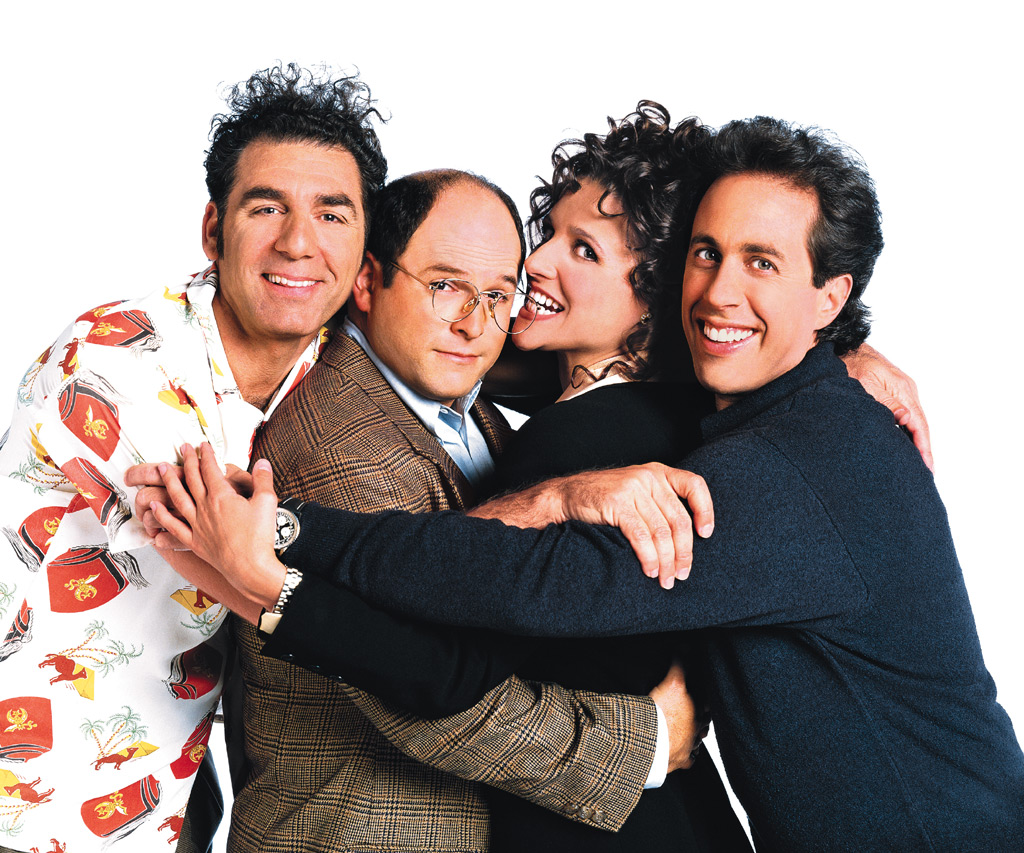
‘Seinfeld’ was a show which celebrated the idea that nothing could mean everything. For nine seasons and over 170 episodes, viewers became emotionally intertwined with the likes of four characters, Jerry Seinfeld, George Constanza, Elaine Benes, and Cosmo Kramer.

For all their narcissistic, conniving, and insensitive traits, viewers still came to sympathize with these highly unlikable characters. These characters never emotionally grew in their nine years of existence, and never attempted to change. They were comfortable with their lifestyle for the most part but yet remained undeniably angry at the world around them. They would constantly fret and agonize over problems at Monk’s coffee shop, or they would journey to Jerry’s apartment to further complain about the injustices perpetrated by society against them. These characters never strived to change, but viewers continued to love them anyways. Perhaps, it was because they could so easily relate to the problems they endured.

Let’s face it. This world is a selfish place. For many people, the world revolves around them and them alone. They are unconcerned with the poor and needy, but are sometimes too afraid to admit this. What ‘Seinfeld’ did was to create an outlet for these people. The show highlighted the fact that people were not alone in this matter. These characters were just as shallow and self absorbed as them. According to Larry Charles, one of the many talented writers for ‘Seinfeld’: “People rarely say exactly what’s on their minds in real life, so by lying, Jerry and George and Elaine and Kramer were all being honest. It’s an honest show about lying” (Seinfeld Forever, Zehme). As heartless and mean-spirited as this sounds, it is undeniably true fact about this sitcom. According to Zehme: “And even if they (the characters) never learned anything, they handily grasped their own limitations as humans, which was an exemplary lesson to the rest of us”.


Ten Years Later


So why is Seinfeld still so important ten years later? To be honest, it is very difficult to answer that question. However, there are many elements that may be noted about why the show was successful in the first place. The show was hilarious, the acting was great, the writing was spectacular, the situations were absurd, the pop culture jargon was innovative, and the supporting cast was well rounded and abstract. In fact, there may not have been one ‘normal’ character on the show. They all had their flaws.

Perhaps this is why the show remains influential to this day. These characters were bizarre and creative, which made them real. No one was perfect, and the situations they created for themselves were inane and ridiculous, but yet somehow remained relevant to the world lived in.

Just recently, a magazine counting down the most important aspects of entertainment in the 1990s was released and deemed, (perhaps) shockingly, that ‘Seinfeld’ was rated number one. The reasons were that the show was considered highly influential and an important mode of entertainment not to be forgotten. This is in some ways amusing considering the fact that the show struggled for its first three seasons to find an audience, and consistently remained on the verge of cancellation. But, as it is with most great shows, ‘Seinfeld’ eventually hits its mark and changed the way the world would forever be embraced.

Society became aware of the fashion no-no’s of the puffy shirt, and the errors in giving advice to a Pakistani restaurant owner on how to spruce up business. Whatever the miniscule incident that occurs in one’s day to day life, ‘Seinfeld’ has more then likely covered it in detail. To say the show is about nothing is an extreme error in judgment. To say the show is a timeless masterpiece may be more fitting. Whatever the case may be, the show will continue to live on as a relevant piece of entertainment for all to enjoy.